Building My Vacation Into a Business
Building My Vacation Into a Business
I have to always be building something with my hands.
That drive started in fourth grade when my family got our first computer. I became obsessed. When my family got this thing called the Internet, and I discovered websites, I immediately wanted to know how it worked, and taught myself HTML and CSS in middle school.
From there, I started my first website development company, FusePointe, during college at Juniata's Sill Business Center. I even received funding to launch it.
I never stopped. Even while working corporate executive roles, I spend my free time coding and helping small businesses because it brings me joy and fulfillment.
I am a creator at heart.
The Swift Learning Sprint
This August, during my vacation time, I decided to finally tackle something I'd been wanting to learn for years. Swift programming.
In college, I learned Android development through Java programming, but I had never learned iOS development. I'm not even sure Swift existed back then.
Moving from an imperative language to a descriptive one was an adjustment. But I'm getting the hang of it.
The timing made sense. I already have Flostack built and running as a stable web application with powerful APIs and marketplace integrations. What I am working on now, are customized mobile companions for niche industries.
That's where Jobflow comes in.
The AI Development Breakthrough
Here's where things got interesting. Learning Swift as a self-taught developer in 2024 means navigating a landscape of AI coding assistants.
The AI coding assistant built into Xcode isn't that great yet, even though you can switch models. I was hitting walls trying to get it to figure out OAuth authentication integration.
That took me a full day to solve.
Eventually, I fed a YouTube video to ChatGPT and asked for a step-by-step breakdown of the code I should put into Xcode. Then I just coded it myself.
But the real breakthrough came when I discovered Cursor.
Cursor is unique. The AI can take a complex task, break it down into a set of steps, and execute those steps in the right order without forgetting to finish. Other AI coding assistants tend to just forget what they were doing before they get 100% through.
Now I use Cursor for coding and Xcode just for building and testing in the iPhone simulator. This workflow changed everything.
Building Wide Before Going Deep
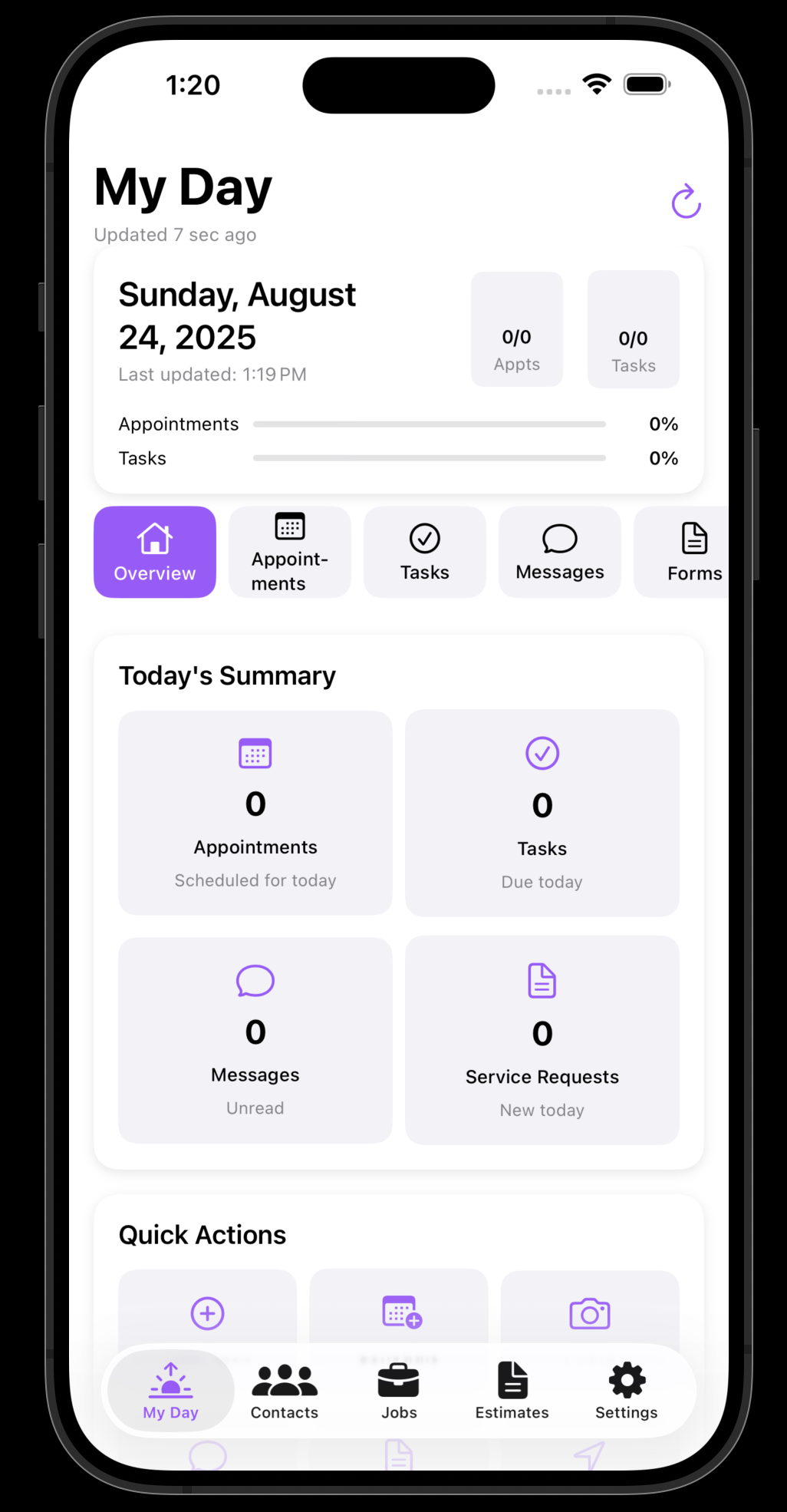
Jobflow will be a lightweight iPhone app specifically for field service technicians. Home service pros can manage their jobs on the go, track time and materials, assign crews to different jobs, see scheduling, and communicate with customers.
But here's my strategic approach that might surprise you.
I'm starting with Jobflow 1.0 for the widest market of home service professionals before narrowing down to specific industries like roofing.
Most people think you should talk to customers first, then build. I'm building first, then validating specific market segments.
This started as a passion project to learn coding. But I have 15 years of experience in customer experience, usability testing, and digital platforms. You'd be surprised how much these business tools share in common.
Regardless of industry, companies need to track customers, sales, projects, employees, costs, and detailed reporting.
So I wouldn't say I'm doing things backwards. I'm starting with universal business needs, then I'll spend time refining features and working directly with roofing companies to meet their exact requirements.
The Technical Reality
When you think about it, what I'm building really isn't that technically complex.
Flostack already exists as a comprehensive platform. Learning Swift is just helping me build the iPhone user interface and native features like push notifications.
The heavy lifting happens through data model setup and proper OAuth integration with existing APIs.
Figuring out how to use Supabase to host edge functions and generate user tokens for OAuth authentication was actually the hardest part. Everything else flows from Flostack's existing infrastructure.
This architecture lets me offer low pricing for small businesses because everything runs at scale through the platform approach.
Market Timing and Opportunity
The home services industry is expected to reach $509 billion by 2025. These businesses are embracing mobile technology faster than ever.
I'm doing extensive research into roofing-specific apps and CRMs, APIs for pricing calculations, and inventory tracking systems. But roofing will need its own specialized implementation.
First, I need to validate market size and demand.
The beauty of this approach is that Jobflow 1.0 will serve the broader home services market while I gather data on which verticals show the strongest adoption and specific feature requests.
Building in Real Time
I'm literally in the middle of this journey right now. The Swift learning, the AI workflow optimization, the market research. It's all happening simultaneously.
What started as using vacation time to learn a new programming language has evolved into a comprehensive mobile strategy for small service businesses.
The creator drive that started in fourth grade never really stops. It just finds new outlets and bigger challenges.
Jobflow represents the mobile piece of a larger vision. Flostack handles the comprehensive business management, while Jobflow puts essential field service tools directly in technicians' hands.
Sometimes the best business ideas emerge not from market research or customer interviews, but from the simple desire to build something new and see where it leads.
The learning continues every day.
